
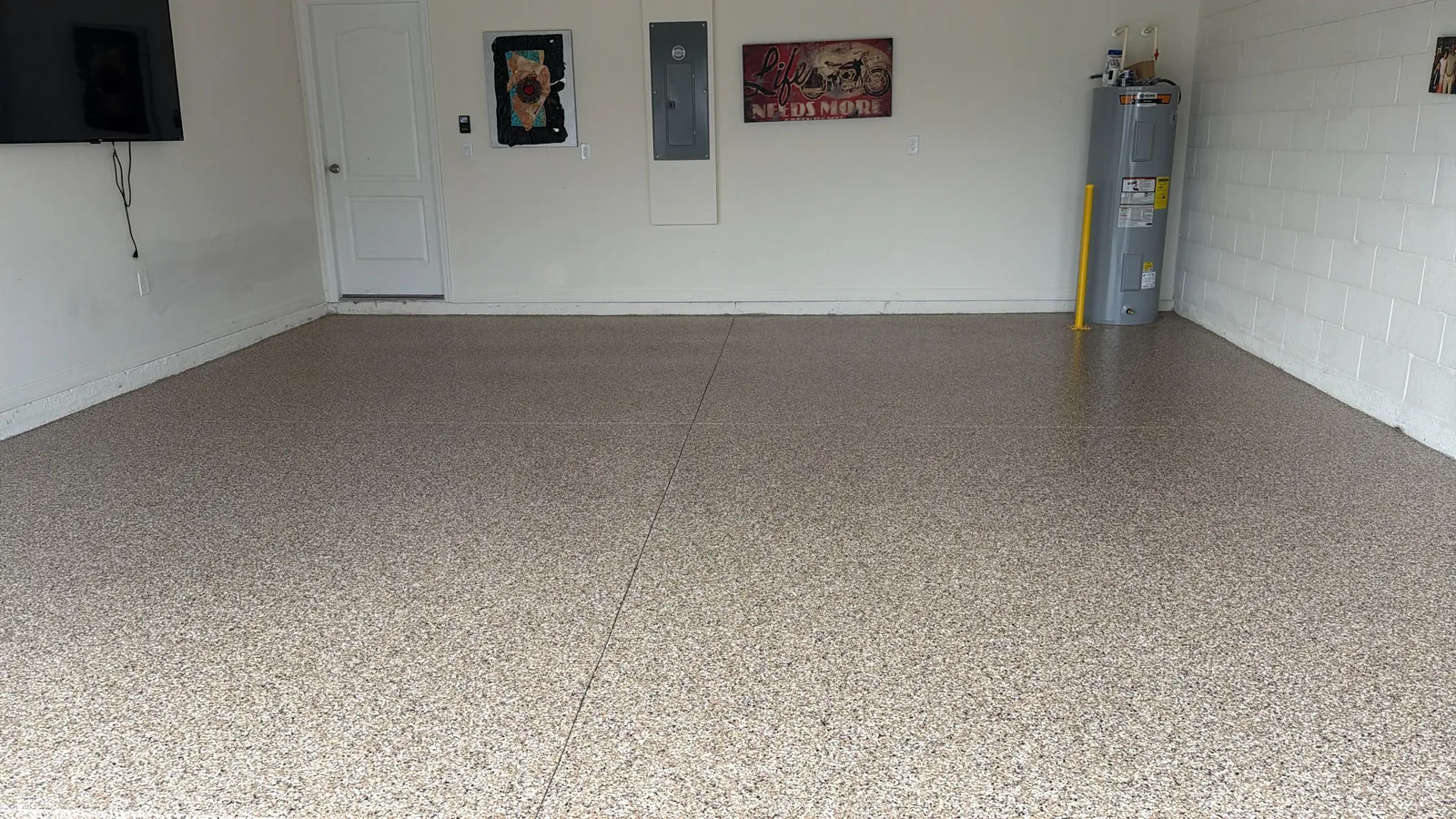
A bare concrete garage floor is one of the easiest home improvements to upgrade - and one of the most impactful. Epoxy floor coating transforms a porous, stain-prone slab into a showroom-quality surface that looks professionally finished, cleans easily and lasts for years. In Florida, though, the specific products and prep process matter enormously - and this is where most DIY epoxy installations go wrong.
This guide covers everything Florida homeowners need to know about epoxy garage floors - what systems actually work in Florida's climate, what they cost, and why professional installation consistently outperforms DIY kits in our environment.
Types of Epoxy Floor Systems for Florida Garages
| System Type | Typical Cost (2-car garage) | Lifespan in FL |
|---|---|---|
| Standard Epoxy (DIY kit) | $200-$600 | 1-3 yrs in FL (yellows) |
| Water-based Epoxy (basic pro) | $1,200-$2,500 | 5-8 yrs in FL |
| Solvent-based Epoxy + Poly topcoat | $2,000-$4,000 | 8-15 yrs in FL |
| Polyurea/Polyaspartic (premium pro) | $3,500-$7,000 | 15-25 yrs in FL |
| Metallic Epoxy (decorative) | $4,000-$8,000 | 10-20 yrs in FL |
Why DIY Epoxy Kits Fail in Florida
Walk into any Home Depot or Lowe's in Central Florida and you'll find epoxy floor kits. Walk into any Ocoee or Winter Garden neighborhood and you'll find peeling, yellowed garage floors where those kits were applied. Here's why:
- Florida concrete moisture: Our climate means concrete slabs often have elevated moisture content from the ground below. Standard epoxy adheres poorly to moist concrete and peels within 1-3 years. Professional installers test moisture levels and use moisture-tolerant primer systems.
- UV yellowing: Consumer epoxy uses standard hardeners that yellow under UV exposure. Florida's 300+ sunny days per year means any UV-exposed garage floor will yellow noticeably within a season. Polyurea topcoats prevent this.
- Surface prep: Kits tell you to etch with acid and mop. Professionals diamond-grind the slab with industrial equipment, opening the concrete's pores for genuine mechanical adhesion. Acid etching alone is not sufficient for long-term performance.
- Hot tire pickup: Florida garages get hot. Standard epoxy softens at high temperatures and sticks to hot tires, pulling off when the car moves. Polyaspartic and polyurea topcoats have much higher temperature resistance.
The Professional Epoxy Installation Process
- Moisture testing: We test concrete moisture content before specifying the primer system. This step is skipped entirely by DIY kits and is a primary cause of adhesion failure in Florida.
- Diamond grinding: We grind the slab with professional diamond grinding equipment to the correct CSP (Concrete Surface Profile) for epoxy adhesion. This removes any existing sealer, paint or contamination and opens pores in the concrete.
- Crack and joint repair: We fill cracks and grind high spots before coating so the finished floor is level and looks flawless.
- Moisture-tolerant primer: Applied to the prepared slab, this bonds to the concrete and provides a stable base for the epoxy system regardless of minor moisture presence.
- Color base coat: Epoxy base coat in your chosen color applied by roller.
- Vinyl flake broadcast: Decorative vinyl flakes broadcast onto the wet base coat at the desired coverage - light, medium or full flake. Flakes add texture, slip resistance and hide imperfections.
- Polyurea/Polyaspartic topcoat: UV-stable clear topcoat applied in one or two coats. This is the layer that resists yellowing, hot tires, chemical spills and abrasion for 15-25 years.
Epoxy Floor Colors and Flake Options
The most popular flake colors for Central Florida garages:
- Charcoal/dark gray blend: Most popular overall - hides dirt, looks sophisticated, works with any home style
- Tan/sand blend: Lighter option that brightens the garage space - popular in newer Hamlin and Watermark homes
- Earth/brown blend: Warm neutral - popular for workshops and spaces where homeowners spend time
- Custom mixes: We can match or complement your home's exterior color palette
- Full-flake vs partial: Full broadcast (100% flake coverage) is the most popular - complete coverage, no bare spots, maximum texture
Epoxy Floor Costs in Central Florida (2026)
| Service | Size | Price Range |
|---|---|---|
| 1-car garage (200-280 sq ft) | Standard flake + polyurea | $1,500-$3,200 |
| 2-car garage (400-500 sq ft) | Standard flake + polyurea | $2,800-$5,500 |
| 3-car garage (600-750 sq ft) | Standard flake + polyurea | $4,200-$7,500 |
| Workshop/commercial space | Per sq ft | $4.50-$8.00/sq ft |
| Metallic epoxy (any size) | Per sq ft | $8.00-$14.00/sq ft |
How to Prepare for Epoxy Installation Day
- Empty the garage completely - including wall-mounted items, shelving and ceiling storage near the slab
- Park vehicles in the driveway - they cannot re-enter the garage for at least 24 hours (48-72 hours for vehicle traffic with standard polyurea)
- Disconnect garage door opener if it opens into the garage during installation
- Plan for 1 full work day for a standard 2-car garage
Free Epoxy Floor Estimate - Central Florida
We assess your concrete, test for moisture and provide a written quote for the right system for your garage and Florida's climate.